
by Jacqueline Epifanie, Chief Marketing Officer, Dispatch Science
The transportation and logistics industry is moving faster than ever, and the technology powering it needs to move even faster. Over the past year, I’ve spoken with countless carriers—local, regional, and national —who are re‑evaluating their tech stack and looking to modernize. What I’m hearing is clear: legacy systems just aren’t cutting it anymore.
We’re now firmly in the era of cloud‑native, AI‑driven Transportation Management Systems. And as you explore what’s out there, the difference between truly modern platforms and legacy systems disguised as “cloud” becomes stark.
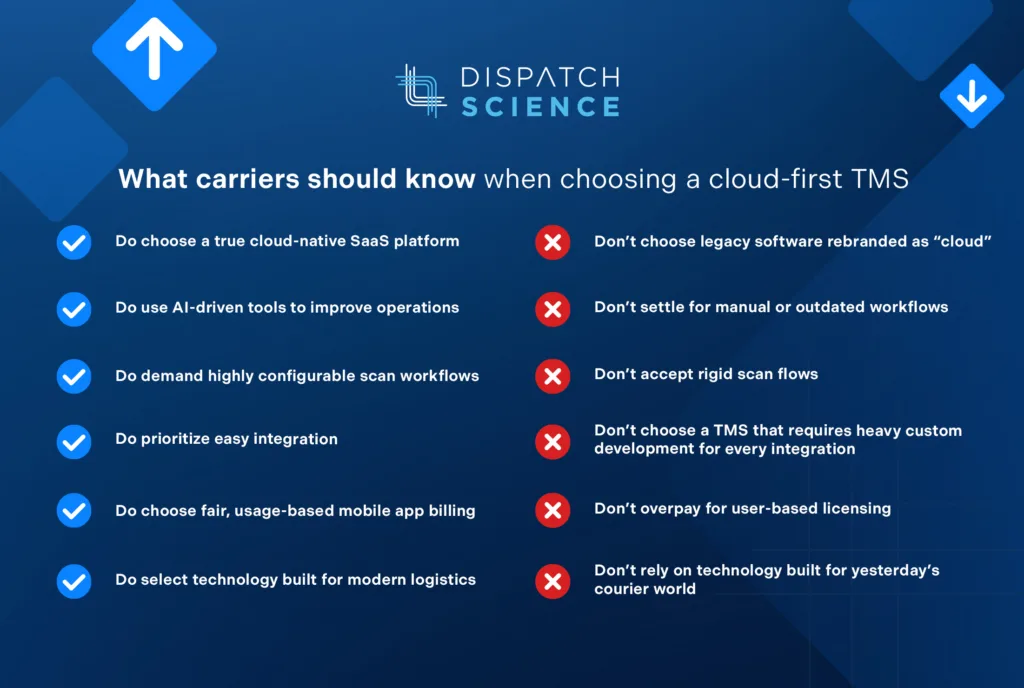
If you’re preparing for the next wave of automation and operational scale, here are the critical Do’s and Don’ts I advise every carrier to consider.
1. Do Choose a true cloud‑native SaaS platform
A genuine cloud‑native TMS delivers continuous upgrades, faster innovation, and zero operational disruption.
No installs. No servers. No patches. No downtime for updates.
If your business needs to scale quickly—or simply wants to stop wasting resources maintaining local systems—cloud‑native is the only path forward.
2.Do Leverage AI‑driven tools
AI is no longer “nice to have.”
It should be embedded directly into your TMS, powering:
- Automated dispatching
- Predictive ETA insights
- Route optimization
- Real‑time visibility
- Exception management
These capabilities free your team from repetitive tasks and help you deliver a faster, more reliable customer experience.
3. Do Demand configurable scan workflows
Every carrier is different—your TMS should respect that.
Your scan events should match your operational reality, not the other way around.
From first-mile pickup through last‑mile delivery, configurable workflows ensure accuracy, traceability, and more meaningful data.
4. Do Prioritize easy integrations
In today’s logistics ecosystem, nothing operates in isolation.
Your TMS should integrate seamlessly with:
- Shippers
- ERP systems
- WMS platforms
- eCommerce ecosystems
And those integrations shouldn’t require months of custom development. Modern platforms offer APIs and built‑in connectors that drastically shorten timelines and reduce cost, and at Dispatch Science we have our iPaaS, Data Bridge.
5. Do Look for fair, usage‑based mobile billing
Growth shouldn’t be penalized with seat‑based licensing.
Your driver mobile app shouldn’t cost you for logins—it should scale based on real activity. Usage‑based billing keeps your cost structure aligned with actual operations.
And now for the Don’ts;
1. Don’t Settle for “cloud‑washed” legacy software
If it still requires installs or servers, it’s not cloud‑native.
Many older platforms have simply been re‑packaged with a hosted environment—but underneath, the architecture hasn’t evolved.
This limits innovation and creates operational friction you shouldn’t have to accept.
2. Don’t Rely on manual or outdated workflows
Manual tasks slow you down and limit your ability to scale.
If your TMS isn’t automating dispatching, routing, and communications, you’re leaving efficiency—and profitability—on the table.
3. Don’t Accept rigid scan flows
If your team is forced into rigid, inflexible scan events, visibility suffers.
And when visibility is limited, so is customer trust.
4. Don’t Choose a TMS that needs heavy custom dev for integrations
You shouldn’t need expensive services every time a shipper wants a connection.
Modern systems allow integrations to be deployed quickly—sometimes instantly.
5. Don’t Overpay for user‑based licensing
Seat‑based pricing restricts growth.
Carrier operations are dynamic—your pricing model should be too.
The Bottom Line: A Cloud‑First TMS Isn’t Just an Upgrade—It’s a Strategy
Choosing the right cloud‑native TMS can fundamentally transform your business. It boosts efficiency, enables automation at scale, and helps you deliver an exceptional service experience to customers. Legacy courier systems weren’t designed for the automation, visibility, and scalability needs of today’s carriers. Modern logistics requires:
- Real‑time data
- End‑to‑end automation
- API‑first architecture
- Cloud scalability
Your TMS should support where your business is going—not keep you anchored to where it used to be. At Dispatch Science, we built our platform precisely for this moment in logistics—where adaptability, visibility, and automation define industry leaders.
Let’s build the future of logistics—together.