
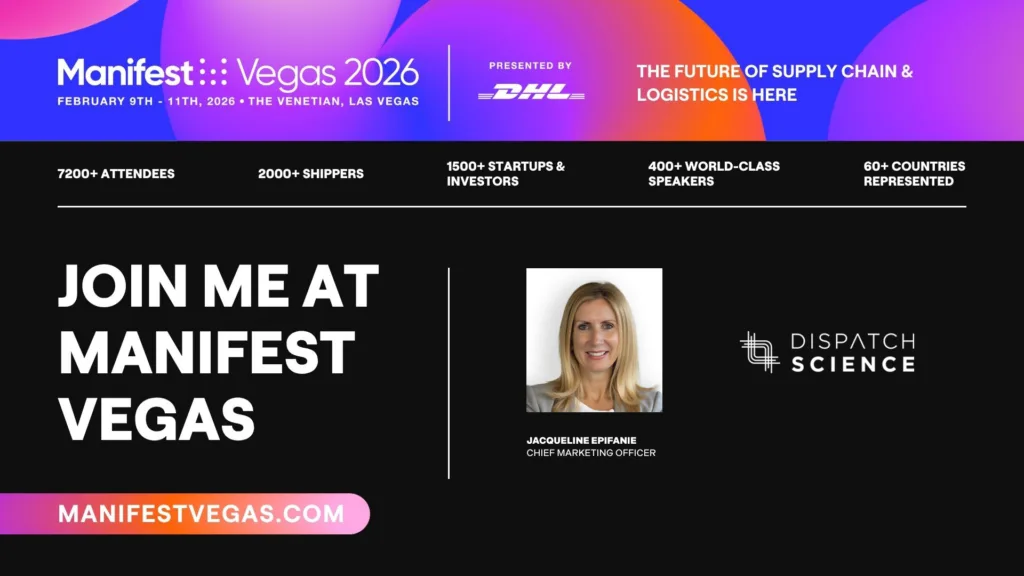
By Jacqueline Epifanie, Chief Marketing Officer, Dispatch Science
Manifest has evolved into a true pulse‑check for where logistics and supply chain conversations are moving next. It’s become one of the rare moments when the entire ecosystem—shippers, carriers, tech innovators, and operators at every stage of maturity—can pause, swap insights, and see how their perspectives align. Every year, the agenda gets bigger, the buzzwords get louder, and the promise of what technology could do gets more ambitious.
In 2026, the challenges are familiar but sharper. Customers expect faster, more transparent service. Margins remain tight. Technology decisions feel more consequential – especially for small and mid-sized fleets looking to grow into larger, more complex operations.
With that in mind, here’s where my attention is focused heading into the show and beyond.
Is AI Finally Showing Real Operational Impact?
AI has gone from a “nice experiment” to a topic nobody in supply chain can avoid. Lots of teams have dabbled with forecasting tools or smarter routing, but only a handful are using AI in ways that change how work gets done on the ground.
The real conversation now is shifting to something much more practical: does AI make frontline decisions better—especially in chaotic environments like last mile, where plans break constantly?
The AI that matters isn’t the flashy, theoretical kind. It’s the kind that helps dispatchers spot the real problems, adjust on the fly, and make confident calls when everything is in motion. This year, the spotlight is moving away from model talk and toward real-world outcomes—where AI is speeding up decisions, reducing stress, and helping teams perform under pressure.
Are Integrations Becoming the New Growth Bottleneck?
Shippers keep raising the bar, and connectivity has become the price of admission. Even small fleets are now expected to plug directly into customer systems—order platforms, inventory tools, ERPs—just to get in the game.
For big operators, the headache is scale: how to handle dozens or hundreds of integrations without slowing momentum. For smaller and mid‑sized fleets, it’s all about speed: how fast they can say “yes” to new business without getting buried in months of technical setup.
Integrations aren’t a back‑office chore anymore—they’re a frontline growth lever. And they’re quickly becoming the backbone for meaningful AI. Better decisions depend on clean, connected data, and when systems don’t talk to each other, both growth and innovation hit unnecessary friction.
What Does “Visibility” Really Mean in 2026?
Visibility has been a dominant theme for years, but the definition continues to evolve. Knowing where an order is matters less than knowing what’s going to happen next – and who needs to be informed when plans change.
Across the industry, there’s growing recognition that dashboards alone don’t reduce friction. Real value comes from timely, accurate ETAs, proactive communication, and systems that support fast intervention when something goes off plan.
In the last mile, where customer experience is shaped in real time, visibility only matters if it leads to better action versus just better reporting.
How Are Operators Managing Growth Without Adding Complexity?
As companies grow, complexity tends to follow: more tools, more workflows, more manual workarounds. Over the past year, many operators – especially those moving upmarket – have started rethinking consolidation, standardization, and simplicity as strategic advantages.
This tension between scale and agility is playing out across fleet sizes, and it’s becoming more pronounced as competition increases, and consolidation accelerates across the industry. Leaders are being forced to ask harder questions about whether their technology helps reduce friction or quietly adds to it.
Where Is Trust Being Built (or Lost) in the Last Mile?
Last-mile delivery is a trust business. Customers trust that an ETA is accurate, an order was handled correctly, and that data reflects reality.
As automation and AI play a larger role, that trust becomes even more important. Small inaccuracies – missed scans, delayed updates, inconsistent data – can quickly erode confidence with customers and partners alike.
As Manifest approaches, we’re less interested in bold predictions than in practical signals. The ones that reflect how delivery businesses are adapting today and what will matter as the industry moves forward.
Come back for part two post-Manifest – where I will share key takeaways from our boots-on-the ground discussions from the show.
Headed to Manifest 2026 too? Come chat with the Dispatch Science Team at Booth #1552.